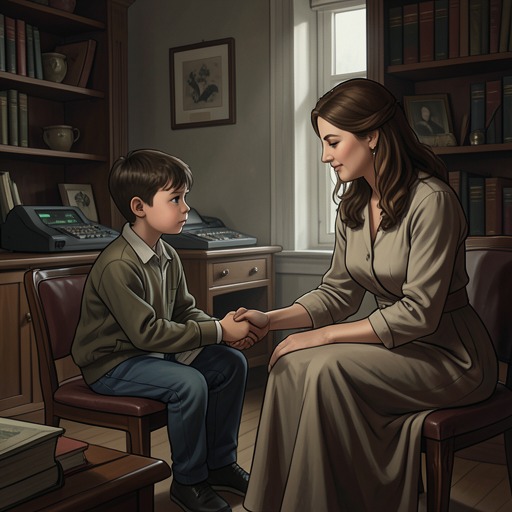
Philip Carey’s club-foot
Of Human BondagePhilip Carey’s club-foot is a persistent bodily condition whose consequences reach well beyond walking: it exposes him to ridicule, narrows his perceived employment options, and becomes a recurring focus of other people’s judgments. Its significance lies both in the practical limits it imposes and in the social encounters that turn a physical difference into a source of shame. As Philip grows older, he learns to conceal how deeply the attention wounds him, but clinical training brings him back into direct contact with the condition and with the possibility of treatment.
Identity and Early Experience
The condition is identified in childhood through the visible limp that marks Philip’s movement. When another boy asks what is wrong with his foot, the question makes explicit the attention Philip already fears. At school, a game of Pig in the Middle turns that difference into a spectacle: unable to catch a runner, Philip watches the others imitate his gait and circle him, laughing. The episode shows how the impairment becomes socially disabling through the response of his peers, not merely through the limits of movement itself.
Philip’s humiliation deepens when the boys make him expose his foot. He later remembers being forced to show it, and the memory remains vivid enough to shape his reaction to examination as an adult. After one such childhood ordeal, he bites into a pillow to keep his sobbing inaudible. His distress, as the narration distinguishes it, comes not simply from pain or exposure but from anger at himself for yielding under pressure. The scene establishes the inward discipline that will recur: Philip tries to master the visible signs of suffering even when he cannot control the circumstances that produce it.
Social Stigma and Self-Presentation
As Philip enters adult life, the foot continues to be treated as an obvious explanation for limitations others assume about him. A remark that his professions will be restricted to work without physical activity turns a bodily condition into a forecast of his economic future. A question about whether he dances likewise invokes his limp as a reason to anticipate exclusion from ordinary social pleasures. These comments differ in tone, but together they show how quickly other people make the foot central to their understanding of him.
Philip recognizes a recurring pattern in such encounters: when someone is angry with him, that person is liable to bring up his club-foot. He comes to judge people by their failure to resist this impulse. In response, he trains himself not to show that the reminder hurts and gains control over the blushing that tormented him as a boy. This is a form of stigma management rather than freedom from stigma; his practiced composure masks an injury that remains active beneath the surface.
Intimacy does not automatically dissolve that self-consciousness. One woman tells him that people notice the foot at first and then forget it, and explains that she raises the subject because she loves him and does not want him to be unhappy. Her reassurance offers a more sympathetic account of how others see him, but it also reveals the persistence of his sensitivity: she can see him blush as she speaks. Elsewhere, another woman’s glance at his limb as they walk makes the condition present without any spoken comment. The foot can thus re-enter an encounter through a look, even when no one explicitly names it.
Work, Poverty, and Practical Limits
The club-foot has material consequences in addition to its emotional and social effects. When Philip faces the prospect of having too little money to live on, he considers possible ways of earning a living and sees how the impairment closes off some routes. He might have sought work connected with medical demand overseas or enlisted in a yeomanry regiment, but he understands that his deformity would have stood in the way. His attempt to find work as an unqualified assistant also fails: the prospective employer notices the foot, then cites Philip’s insufficient hospital experience. Philip suspects that this explanation conceals a preference for an assistant who can be more active.
The pressure of financial insecurity makes these exclusions more than abstractions. Philip is forced to seek income while still unqualified, and his condition compounds the disadvantages of his position. In this context, the foot operates neither as a complete explanation for his hardship nor as an incidental detail. It is one constraint among several, but a conspicuous one that employers and Philip himself must reckon with.
The Clinical Encounter and Possible Treatment
Medical training changes Philip’s position in relation to the club-foot without removing his personal history of it. During a case involving a boy with the same condition, Philip examines the child’s foot and wonders why the boy seems free of the humiliation that has oppressed him. The contrast makes visible how profoundly his own experience has shaped his interpretation of the condition: the boy’s body is before him as a clinical case, but it also recalls the shame Philip carries from school.
A surgeon identifies Philip’s condition as talipes equinus and asks him to remove his boot so the foot can be examined. His hands tremble as he struggles with the laces, and the childhood memory of being compelled to show the foot returns. The clinical setting does not neutralize the experience. Even in adulthood, surrounded by medical students and a surgeon, the examination repeats the old exposure in a different institutional form.
The surgeon suggests that an operation might improve the foot, while making clear that it cannot make it normal. Philip has long wondered whether treatment was possible, but his aversion to discussing the subject kept him from consulting hospital surgeons. He believes that treatment might at least allow him to wear a more ordinary boot and limp less. The prospect is therefore limited but concrete: a change in appearance and mobility, not a cure that would undo the history of stigma.
Philip later asks Mr. Jacobs, the assistant-surgeon he has worked with, to perform the operation. Jacobs agrees because he is interested in neglected cases of talipes and is collecting material for a paper. He again warns that the foot cannot be made like the other, though he expects to improve it enough for Philip to wear a less unsightly boot. He also cautions that a club-foot may be a handicap in medical practice because patients may dislike a doctor who has a visible physical condition. Treatment thus promises a practical benefit while leaving the social prejudice intact.
Narrative Significance
The novel repeatedly places Philip’s foot between his private experience and public interpretation. At school, other boys turn his gait into a joke; in adult life, acquaintances invoke it in conversation, potential employers may read it as a limitation, and a clinical audience makes it an object of examination. These scenes show how a visible impairment can be made socially consequential through scrutiny, assumptions, and institutional expectations.
At the same time, the condition is not reduced to a single symbolic meaning. It affects Philip’s movement and work possibilities, shapes his self-presentation, and brings back memories of specific humiliations. His efforts to hide his hurt coexist with moments in which another person offers reassurance and with the more practical question of whether surgery could help. The operation’s limited promise preserves this tension: Philip may gain a less conspicuous boot and limp less, but neither medicine nor composure can guarantee that other people will stop treating the foot as a measure of his capacities.